

It’s time to start getting excited because Chinese New Year is approaching! Abundant food, warm family gatherings, and each year’s highlight—the red packets. However, this article is for those in the gray area we rarely talk about, couples or individuals who are giving for the first time this year. If you relate to being in this group, here is an essential guide to giving (and receiving) red packets!
Who should get them?
Married couples are meant to give children and unmarried youth red packets, with the meaning of giving good fortune to them. A piece of good news for our singles on the other hand, you are not required to distribute red packets!
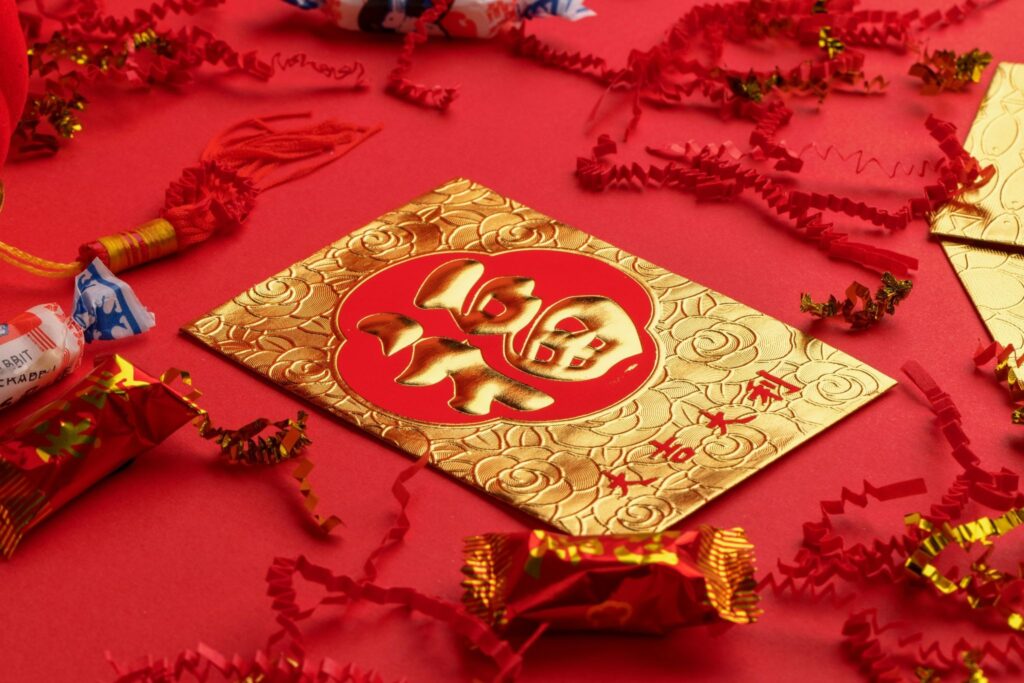
As for parents and elders, red packets are given as a gesture of love and respect, which is also why larger amounts are generally given.
Red packets should also be prepared in advance to service providers such as security guards, cleaners, and helpers as a token of gratitude for their work.
Hierarchy
Traditionally, married couples give red packets to children and unmarried younger relatives. Elders on the other hand, typically hand out red packets to all juniors.

Depending on how close you are to the recipients, amounts can differ greatly. More generous amounts are given to immediate family and close relatives, while smaller amounts are given to distant relatives, friends, and service staff.
How much to give
Red packet amounts should be in even numbers as they are considered auspicious numbers. Even among the even numbers, amounts ending in the number eight are considered the most favourable due to being associated with wealth and prosperity.
However, you should avoid ending your amount in the number four, as it sounds like “death” in Mandarin, thus regarded as an unlucky number. Coins and odd numbers in your red packets should also be avoided in general.
You can also refer to our chart below:
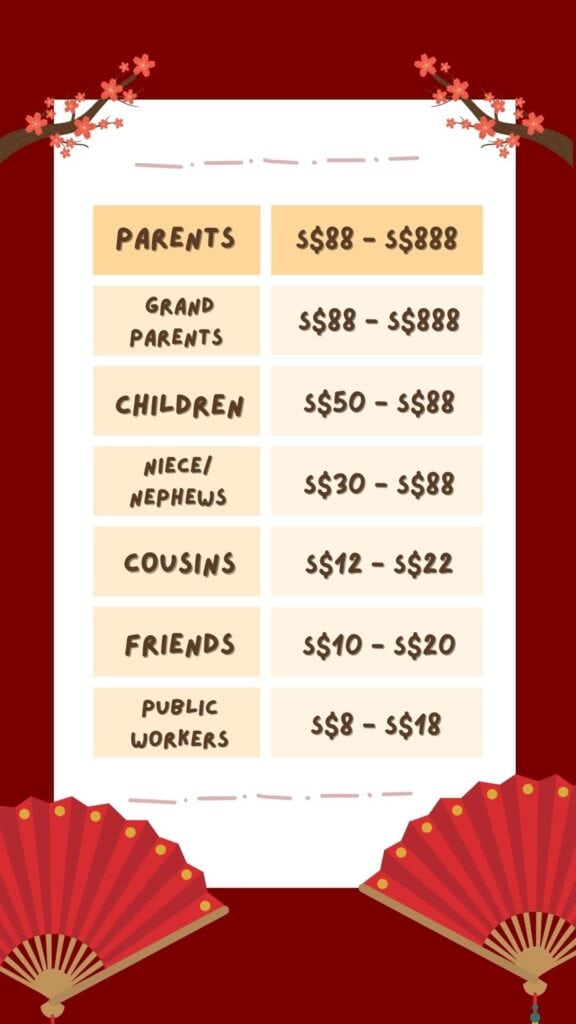
Still, the most important factor is your budget. During this time of giving and prosperity, it is the thought of giving and blessing that counts more than the amount itself. Be sure to give within your means, and remember that this tradition is about practising gratitude!
Symbolising a fresh start and new beginnings, new notes should be used if cash is given. Due to this custom, new notes are specifically printed at a higher volume during the period leading up to Chinese New Year. Thus, if you are planning to use physical notes this year, it’s best to withdraw your new notes as soon as possible. Apart from the new-notes practice, e-hongbaos are also becoming more common as an eco-friendlier option.
Etiquette
Always receive your red packet in person, and accept it with two hands as a sign of respect.
Do not open the red packet in front of the person who gave it to you. Instead, you can check it privately at the end of the day or when the New Year visiting period is over.

When giving red packets to elders, always include a pair of tangerines as a token of abundance and respect.
Share words of fortune and blessings like 年年有余 (nian nian you yu) which means to wish for abundance, or 万事如意 (wan shi ru yi) that means to prosper in whatever you do. If you can’t remember these phrases, simple words like 新年快乐 (xin nian kuai le) meaning Happy New Year or 恭喜发财 (gong xi fa cai) meaning wishing for wealth will also do.
We hope that this guide has given you a clearer idea of how to give (and receive) these generous tokens of prosperity, and may your Chinese New Year celebrations shout huat ah!
For more lifestyle updates like this, subscribe to our Telegram channel at @confirmgood.